
Why You Must Switch to Algorithmic Directives (The Taxonomy of Intent)
Table of Content
You are using Generative AI wrong.
This is not a criticism of your intelligence. It is a criticism of your methodology. Most developers, writers, and strategists treat Large Language Models (LLMs) like a magical search engine. They type a sentence, hit enter, and hope for a miracle. They treat the AI like a slot machine.
Sometimes you win. Usually, you lose.
If you want consistent, high-value output, you must stop “prompting.” You must start engineering. You need a system that replaces vague requests with precise, executable logic. You need a taxonomy.
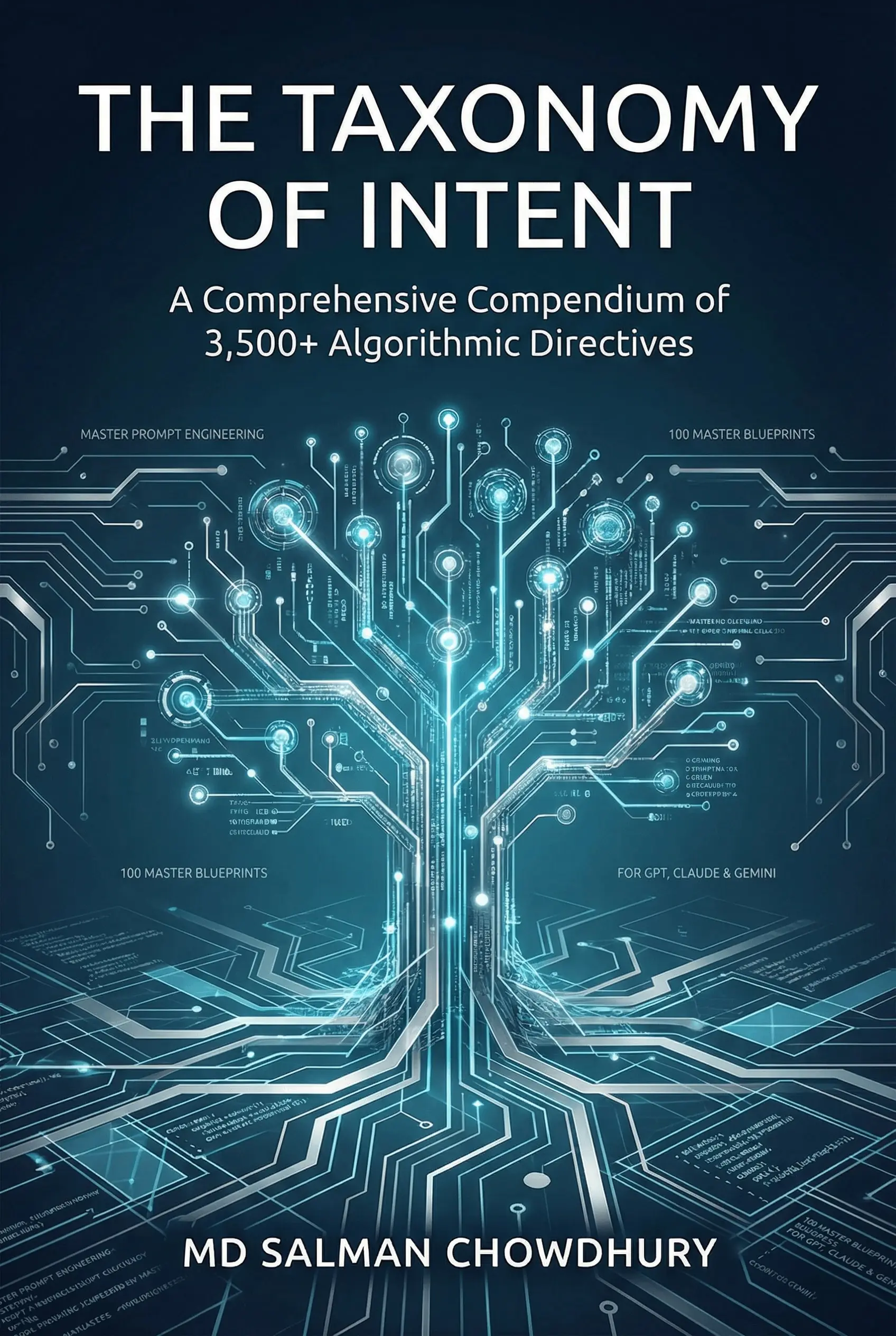
This article is the documentation for that system. It is an introduction to The Taxonomy of Intent, a living compendium of 3,500+ algorithmic directives available right here on readon.site.
We will break down why your current prompts fail, the physics of “Intent Architecture,” and how to use specific Blueprints—like Reverse Brainstorming and Constraint-Based Creativity—to force the AI to function at the top 1% of its capability.
The 1% Rule: Why Systems Beat Motivation
James Clear, author of Atomic Habits, argues that you do not rise to the level of your goals; you fall to the level of your systems. In the context of AI, this is the “Iron Rule.”
A “goal” is wanting a viral blog post. A “system” is the prompt architecture that guarantees it. If you rely on your own creativity to write a new prompt every time you open ChatGPT or Claude, you are introducing friction. Friction kills consistency.
The Taxonomy of Intent removes this friction. It is not a collection of “cool tricks.” It is a library of Algorithmic Directives—pre-validated, logic-heavy instructions that force the LLM into specific cognitive states.
By using a Directive, you improve your output by 1% with every interaction. Over a year, this compounds into a competitive advantage that is mathematically impossible to catch.

The Physics of Intent Architecture
Before we analyze the specific Blueprints, you must understand the mechanism. Why do Directives work better than conversational prompts?
An LLM is a probabilistic engine. It predicts the next token based on the context window. When you provide a vague context (“Write a story”), the probability distribution is flat. The model can go anywhere. It usually chooses the path of least resistance: clichés, tropes, and hallucinations.
Intent Architecture is the art of constraining that probability distribution. It erects walls around the model, forcing it down a specific narrow corridor of high-quality thought.
The 4 Pillars of a Directive
- The Persona (Role): Who is the processor? (e.g., “You are a Senior Systems Architect.”)
- The Constraint (Negative Space): What is forbidden? (e.g., “Do not use adjectives. Do not use the word ‘delve’.”)
- The Task (Action): What is the specific cognitive operation? (e.g., “Invert the logic.”)
- The Output (Format): How is the data structured? (e.g., “JSON,” “Markdown Table,” “Python List.”)
When you combine these four pillars, you stop playing the slot machine. You start writing code in natural language.
Case Study 1: The Innovation Trap
Problem: You need to solve a complex business problem (e.g., “How do I lower user churn?”). You ask the AI for ideas. It gives you generic advice: “Send better emails,” “Improve UI.”
Diagnosis: This is the “Positivity Bias.” LLMs are trained to be helpful and agreeable. They naturally gravitate toward positive, additive solutions.
The Solution: Blueprint 30.
To break this bias, we use Blueprint 30: Reverse Brainstorming. This Directive forces the model to invert the problem. Instead of asking how to save the user, you command the AI to destroy the user.
The Logic of Inversion
By asking, “How can we ensure every user deletes the app in 24 hours?”, you force the model to access a different cluster of its neural network. It identifies friction points, annoyances, and bugs that it would otherwise ignore.
Once you have the “Destruction List,” you simply invert it to find the “Protection List.”
This is not just a brainstorming technique; it is a survival strategy. If you cannot identify how your system fails, you cannot protect it.
[Action Step]: Do not just read about it. Test the Reverse Brainstorming Blueprint on your current project today.
Expanding the Horizon
Once you have inverted the problem, you need to widen the solution space. This is where Blueprint 25: Divergent Thinking comes in.
Most people use AI for convergent thinking (narrowing down options). Blueprint 25 forces the model to ignore probability and focus on possibility. It generates “Black Swan” ideas—concepts that seem statistically unlikely but carry outsized potential returns.
Case Study 2: The Creativity Paradox
Problem: You are staring at a blank page. You need to write a compelling introduction or a unique algorithm, but the AI keeps giving you “safe” corporate speak.
Diagnosis: Freedom is the enemy of creativity. When an LLM has infinite choices, it chooses the average. This is the “Regression to the Mean.”
The Solution: Blueprint 29.
We solve this with Blueprint 29: Constraint-Based Creativity. This technique is inspired by the Oulipo movement (Ouvroir de littérature potentielle), a group of French mathematicians and writers who believed that arbitrary rules unlock genius.
The “Cage” Technique
Blueprint 29 applies artificial restrictions to the prompt. For example:
- “Explain this Python script using only one-syllable words.”
- “Write a product description without using the letter ‘e’.”
- “Summarize this report in exactly 6 sentences, each starting with a subsequent letter of the acronym S.M.A.R.T.”
Why does this work? It forces the AI (and you) to abandon the “easy” neural pathways. It must search deep into its latent space to find words that fit the puzzle. The result is writing that feels fresh, punchy, and uniquely human.
If your content feels flat, apply a constraint. Use Blueprint 29 to force the model out of its comfort zone.
Case Study 3: The Clarity Engine
Problem: You have a complex technical product—perhaps a SaaS platform or a blockchain protocol—and your marketing copy is impenetrable. Users are bouncing because they do not understand what you do.
Diagnosis: The “Curse of Knowledge.” You know too much. You assume the user knows the jargon. The AI mimics your complexity.
The Solution: Blueprint 27 & 28.
You need to bridge the gap between “Technical Truth” and “User Reality.”
The Metaphor Bridge
Blueprint 27: Metaphorical Connection is designed to map abstract concepts onto concrete physical realities.
It does not just say “Use a metaphor.” It commands the AI to:
- Analyze the structural relationships in the technical concept (e.g., API calls).
- Scan for a real-world domain with similar relationships (e.g., a Restaurant Kitchen).
- Map the components 1:1 (User = Customer, API = Waiter, Server = Kitchen).
This creates explanations that “click” instantly. It turns “asynchronous data fetching” into “ordering a coffee and waiting for your name to be called.”
Sensory Immersion
Once they understand the concept, you need to make them feel it. Blueprint 28: Sensory Expansion takes dry text and injects visceral triggers.
It commands the AI to describe the “texture” of the software, the “rhythm” of the workflow. It sounds abstract, but it increases dwell time. Readers stay when they are engaged emotionally, not just intellectually.
The System: How to Use the Taxonomy
The Taxonomy of Intent is not a book you read once and shelve. It is a reference manual. It is a toolbox.
You should treat the main index page as your command center. Bookmark it.
When you face a specific cognitive bottleneck, look up the corresponding Blueprint:
- Stuck on sales copy? Use Blueprint 26: Narrative Reframing to pivot customer objections into features.
- Need a new product angle? Use Blueprint 25: Divergent Thinking to explore adjacent markets.
- Debugging code? There are Blueprints coming for that, too.
The “Ghost” Protocol
Remember the persona of this site: The Ghost in the Code. We prioritize anonymity and efficiency. The Blueprints are designed to strip away the “AI personality” (the “As an AI language model…” fluff) and deliver raw, usable data.
Every Blueprint in the Taxonomy includes a “Role” and a “Constraint” specifically designed to silence the robot and amplify the signal.
Conclusion: Stop Guessing. Start Engineering.
The era of the “Prompt Whisperer” is over. We are entering the era of the AI Systems Architect.
You can continue to treat AI like a toy, typing random questions and accepting random answers. Or you can professionalize your workflow. You can adopt a Taxonomy of Intent.
The choice is binary. Randomness or Precision. Chaos or Engineering.
Go to The Taxonomy of Intent. Pick one Blueprint. Execute it. Observe the difference.
One percent better every day.
-
Master prompt engineering with 3,500+ AI prompts across 100 Master Blueprints and 35 sectors. This comprehensive guide teaches you to create, customize, and optimize effective prompts for GPT, Claude, and Gemini. Perfect for developers, content creators, and AI practitioners seeking practical, real-world prompting techniques and blueprints.
-
1.8 K • Dec 30, '25
-
1.9 K • Dec 30, '25
-
1.9 K • Dec 30, '25
-
0 Comments